Across UK manufacturing and industrial sectors, the engineering skills gap is widely recognised as one of the most pressing challenges facing businesses. Employers are struggling to recruit and retain qualified engineers and technicians, with projections indicating a significant shortfall in the workforce needed to sustain growth and innovation through the end of this decade.
Recent data from the UK’s engineering and technology sector shows that many organisations lack core digital and automation skills, with around 30% reporting gaps in automation capabilities and a growing difficulty in recruiting data and software engineering expertise. These shortages are compounded by an ageing workforce and a decline in the number of young people entering technical roles, creating a highly competitive labour market and placing increasing pressure on maintenance teams.
These workforce challenges are unfolding against a broader backdrop of pressure across UK manufacturing. Recent industry surveys reported by Business Live highlight that the sector is approaching a critical “tipping point”, with rising employment and energy costs squeezing margins and dampening investment confidence. According to a Make UK survey, almost nine in ten senior manufacturing executives expect employment costs to rise this year, with many warning that cost pressures could force investment plans to be delayed,scaled back or moved overseas.
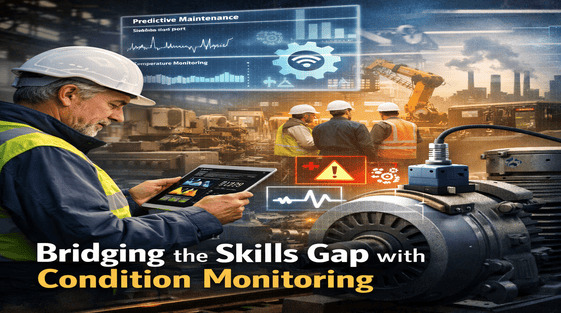
Within this context, condition monitoring technologies represent a strategic response to workforce constraints, enabling organisations to do more with less, reduce unplanned downtime, and maintain high standards of plant reliability despite increasingly stretched maintenance resources.
Bridging the Skills Gap with Technology
Condition monitoring systems capture real time data on vibration, displacement, temperature and other key performance indicators across machinery. This continuous flow of information provides clear insight into equipment health, allowing maintenance teams to identify early signs of wear or failure before they escalate into costly breakdowns. By prioritising data driven insights, organisations can reduce the frequency of time based, manual inspections, which would allow skilled engineers to focus on higher value tasks that genuinely require human expertise.
This shift has become particularly important as traditional maintenance models falter under labour pressure. Predictive maintenance approaches, supported by condition monitoring, optimise maintenance schedules based on actual machine condition rather than arbitrary service intervals. The result is improved equipment uptime, fewer emergency call outs and more efficient use of scarce technical talent.
The Business Case for Condition Monitoring
The practical benefits are clear. Real time condition monitoring enables organisations to plan maintenance around production schedules, improving overall equipment effectiveness while lowering operating costs.
Across sectors including manufacturing, processing, energy and critical infrastructure, these technologies help balance operational demands with workforce limitations. With fewer experienced technicians available on site, remote monitoring and automated fault detection reduce the need for specialist staff to be physically present for routine inspections. This not only speeds up decision making but also helps organisations maintain safety and compliance standards with smaller teams.
Industry Trends and Workforce Realities
The skills shortage is not confined to one niche. Across the UK engineering sector, organisations continue to highlight digital skills gaps affecting automation, data analysis and advanced equipment management. These are precisely the areas where condition monitoring delivers the greatest value by integrating reliable sensor data with practical maintenance decisions and acting as a force multiplier for experienced engineers.
Recent industry analysis continues to emphasise the importance of digital transformation in addressing persistent workforce challenges, with technology playing a central role in maintaining competitiveness, resilience and operational continuity.
Skills, Technology and Strategic Advantage
While training programmes and apprenticeships remain essential to rebuilding long term engineering capacity, condition monitoring provides an immediate and practical way to mitigate skills shortages today.
By automating routine data collection and delivering actionable insights, these systems allow organisations to maximise the effectiveness of their existing workforce, protect critical assets and maintain operational performance in an increasingly constrained labour environment.